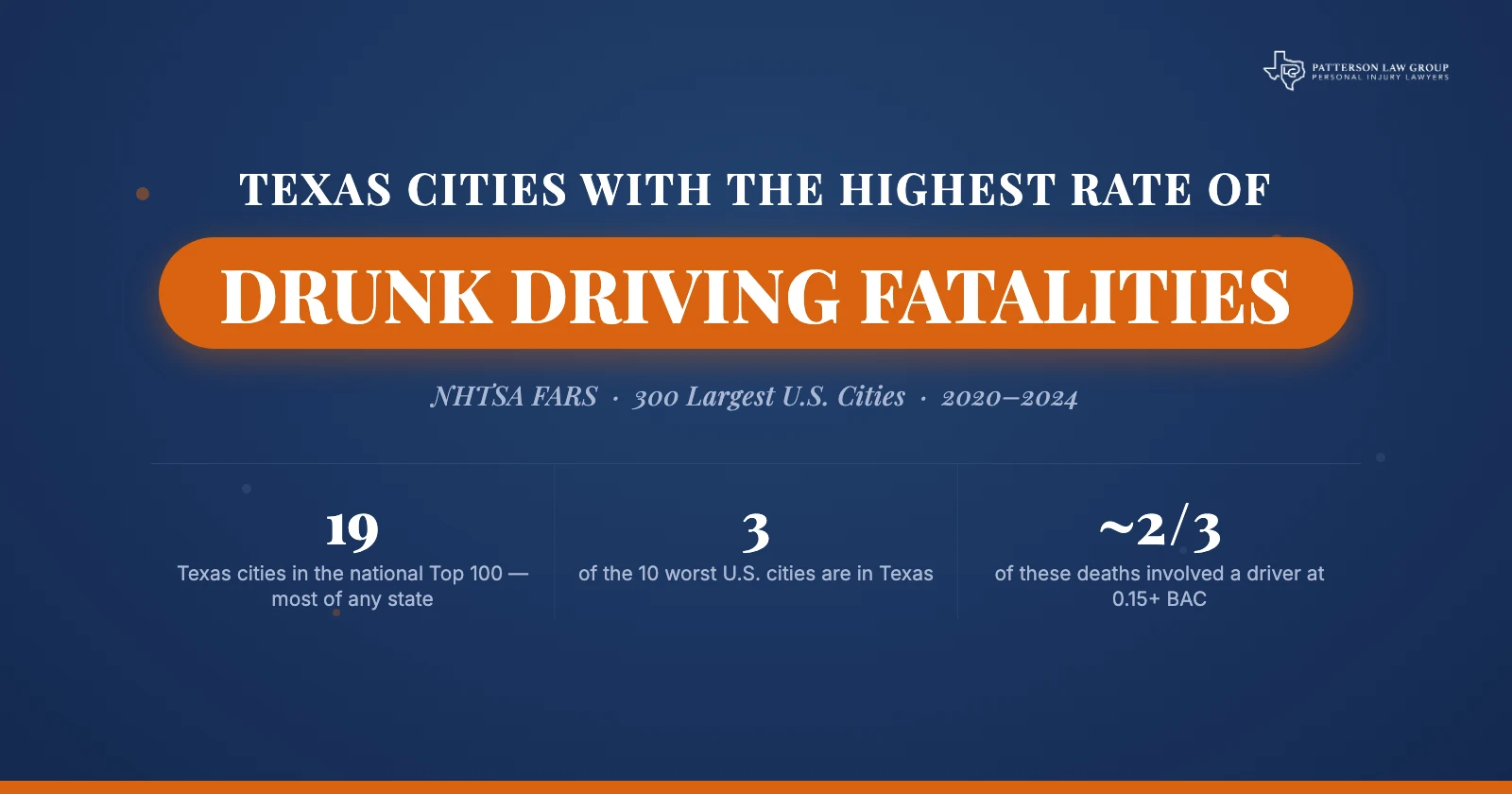
Federal crash data from 2020 through 2024 confirms what earlier numbers already suggested: fatal drunk driving is not spread evenly across the country, and Texas communities show up again and again among the most dangerous places in America. Using the National Highway Traffic Safety Administration’s Fatality Analysis Reporting System (FARS), we reviewed the 300 largest U.S. cities and ranked the 100 with the highest per-capita rate of people killed in crashes involving an alcohol-impaired driver — a driver with a blood alcohol concentration (BAC) of 0.08 or higher. Nineteen of those Top 100 cities are in Texas, from oil-patch and highway-corridor towns like Odessa and Beaumont to every one of the state’s major metros: Dallas, Houston, San Antonio, Fort Worth, Austin, El Paso, and Arlington.
Across the 100 highest-risk cities, an estimated 9,724 people were killed in crashes involving an alcohol-impaired driver between 2020 and 2024, and 6,515 of those deaths involved a driver at 0.15 or higher. Roughly two out of every three of these deaths involved a driver at nearly twice the legal limit.
Key Findings at a Glance
- 19 Texas cities rank among the 100 worst U.S. cities for fatal drunk driving — more than any other state.
- 3 of the 10 worst cities nationally are in Texas: Odessa (#2), Beaumont (#5), and Dallas (#8).
- Odessa ranks #2 among the 300 largest U.S. cities at 53.0 alcohol-impaired driving deaths per 100,000 residents — second only to Memphis, Tennessee.
- Texas cities make up about 28% of the population in the Top 100 but account for 30% of the deaths and 31% of the most extreme cases.
- In Midland, Odessa, Corpus Christi, and San Antonio, roughly 70–82% of these deaths involved a driver at 0.15 or higher — nearly twice the legal limit.
- Nationally, alcohol-impaired driving killed an estimated 11,904 people in 2024 — about one death every 44 minutes — though deaths have fallen for three straight years.
Texas on the National Map
For the first time since we began ranking the U.S. cities with the highest fatal drunk-driving rates, the single worst city in the country is not in Texas — Memphis, Tennessee now tops the list at 60.1 alcohol-impaired driving deaths per 100,000 residents. But that does little to soften the picture for Texas. The state still places more cities in the Top 100 than anywhere else, still claims three of the ten worst, and still posts a big-city average (27.8 deaths per 100,000) above the Top 100 average of 26.3.
Of the 100 cities with the highest per-capita rates, the 19 Texas cities account for about 28 percent of the combined population but an outsized share of the harm — about 30 percent of all alcohol-impaired driving deaths and roughly 31 percent of the most severe 0.15+ cases.
The 10 Worst Cities Nationally (2020–2024)
| Rank | City | Deaths per 100k | % involving 0.15+ |
|---|---|---|---|
| 1 | Memphis, TN | 60.1 | 63% |
| 2 | Odessa, TX | 53.0 | 77% |
| 3 | St. Louis, MO | 49.4 | 70% |
| 4 | Cleveland, OH | 42.4 | 68% |
| 5 | Beaumont, TX | 41.1 | 67% |
| 6 | Baton Rouge, LA | 38.5 | 68% |
| 7 | Tucson, AZ | 37.8 | 65% |
| 8 | Dallas, TX | 37.6 | 67% |
| 9 | Jackson, MS | 36.3 | 66% |
| 10 | San Bernardino, CA | 35.3 | 64% |
Small Texas Cities, Big Rates
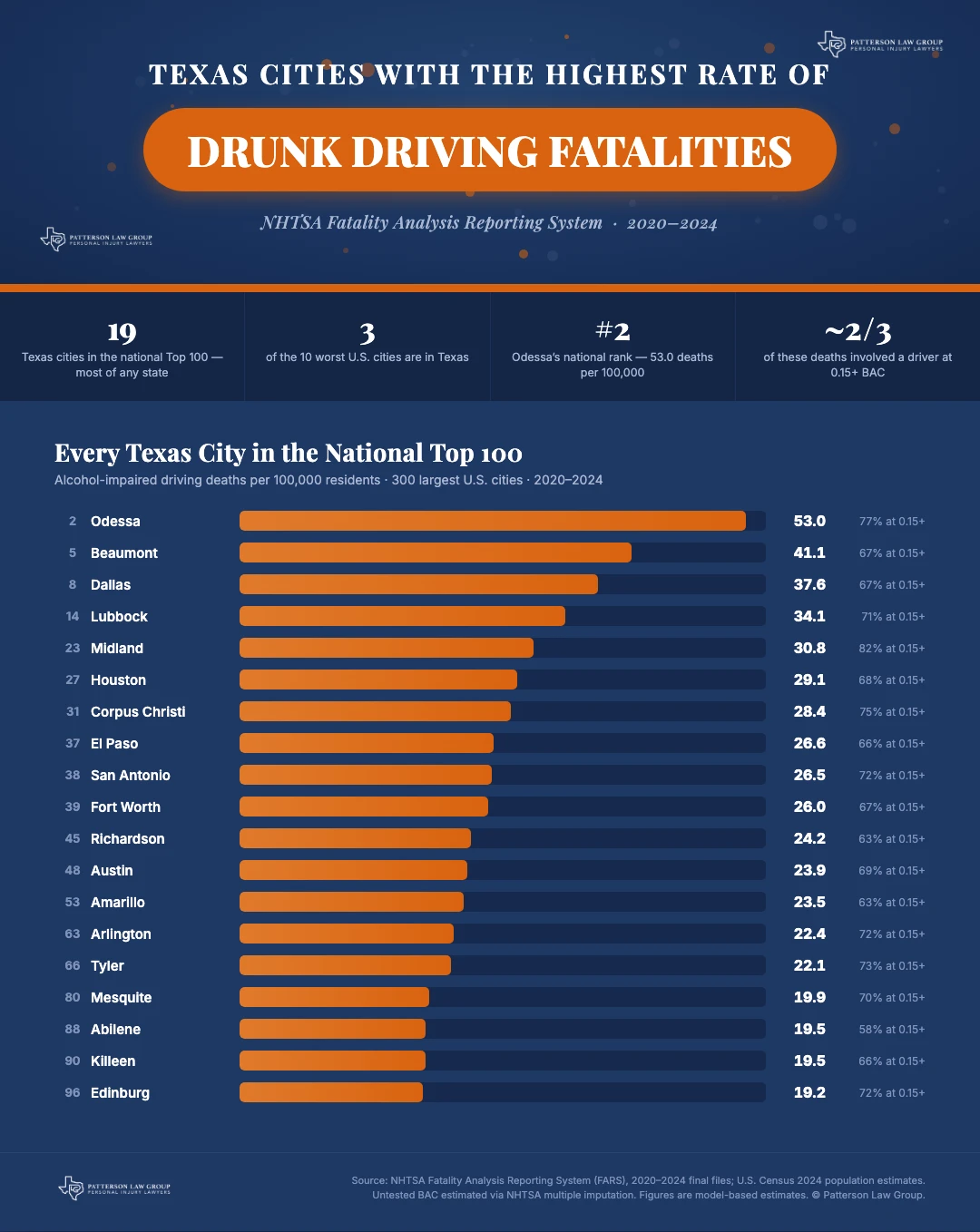
Because the rankings are built on rates rather than raw counts, smaller cities with repeated alcohol-related deaths rise to the top. Odessa leads all of Texas and ranks second nationally at 53.0 deaths per 100,000 residents — more than double the Top 100 average — with 77 percent of those deaths involving a driver at 0.15 or higher. Beaumont follows at 41.1 per 100,000 (fifth nationally), then Lubbock at 34.1 and Midland at 30.8, where an extraordinary 82 percent of these deaths involved a driver at the aggravated 0.15+ level.
These communities share a profile: long, high-speed highway corridors, late-night driving, energy-sector traffic that keeps vehicles on the road overnight, and limited transit alternatives. A city that records a few dozen alcohol-related deaths over five years can post a per-capita rate two or three times the national big-city average.
Texas’s Major Metros
Dallas stands out among large cities, ranking eighth in the nation at 37.6 deaths per 100,000 residents and 498 alcohol-impaired driving deaths over five years. Houston (29.1 per 100,000; 695 deaths), El Paso (26.6), San Antonio (26.5; 404 deaths), Fort Worth (26.0; 263 deaths), Austin (23.9), and Arlington (22.4) all rank inside the Top 100. Their per-capita rates are lower than the small-city outliers, but their large populations mean the absolute number of families affected is enormous.
Every Texas City in the National Top 100
| Natl. Rank | Texas City | Deaths /100k (5yr) | AI Deaths | % involving 0.15+ |
|---|---|---|---|---|
| 2 | Odessa | 53.0 | 64 | 77% |
| 5 | Beaumont | 41.1 | 46 | 67% |
| 8 | Dallas | 37.6 | 498 | 67% |
| 14 | Lubbock | 34.1 | 93 | 71% |
| 23 | Midland | 30.8 | 44 | 82% |
| 27 | Houston | 29.1 | 695 | 68% |
| 31 | Corpus Christi | 28.4 | 90 | 75% |
| 37 | El Paso | 26.6 | 181 | 66% |
| 38 | San Antonio | 26.5 | 404 | 72% |
| 39 | Fort Worth | 26.0 | 263 | 67% |
| 45 | Richardson | 24.2 | 29 | 63% |
| 48 | Austin | 23.9 | 237 | 69% |
| 53 | Amarillo | 23.5 | 48 | 63% |
| 63 | Arlington | 22.4 | 91 | 72% |
| 66 | Tyler | 22.1 | 25 | 73% |
| 80 | Mesquite | 19.9 | 30 | 70% |
| 88 | Abilene | 19.5 | 26 | 58% |
| 90 | Killeen | 19.5 | 31 | 66% |
| 96 | Edinburg | 19.2 | 21 | 72% |
The Role of Extreme Intoxication
The severity inside these numbers matters as much as the volume. A death counts here if it occurred in a crash where at least one driver had a BAC of 0.08 or higher, but many states and safety organizations treat 0.15 — nearly double the legal limit — as an aggravated threshold tied to sharply higher crash risk. Across the Texas cities in the Top 100, about two-thirds of these deaths involved a driver at 0.15 or higher, and in Midland, Odessa, Corpus Christi, and San Antonio the share reached roughly 72 to 82 percent. That points to heavy binge drinking and chronic alcohol misuse, not borderline cases just over the limit.
The National Trend
The five-year window also captures an important shift. Alcohol-impaired driving deaths peaked in 2021 and have declined each year since; NHTSA estimates 11,904 people were killed in alcohol-impaired crashes in 2024, down 3.9 percent and the third consecutive annual improvement. Even so, that is roughly one life lost every 44 minutes, and the concentration of risk in Texas cities has barely moved.
Why So Many Texas Cities Rank High
There is no single explanation, but several themes repeat. Texas has long stretches of high-speed highway that make late-night mistakes deadly. Many cities have vibrant bar and nightlife districts sitting close to fast arterial roads and interstate ramps. A deeply car-dependent culture means driving is often the default even after drinking, and rapid suburban growth has outpaced public transit in much of the state. Layered on top of national patterns in alcohol-impaired driving, these local conditions push Texas communities toward the top of the rankings year after year.
From Data to Prevention
Communities reduce these deaths with a mix of strategies: designated-driver and rideshare campaigns, ignition-interlock requirements for high-risk offenders, and high-visibility enforcement targeted at known hot spots and peak hours. Increasingly, cities are also studying where dangerous corridors and nightlife clusters overlap, then redesigning roads and late-night transportation options around them. The 2020–2024 data shows where focused intervention could do the most good — and in Texas, that map is unfortunately familiar.
How the Rankings Were Compiled
This analysis uses the Fatality Analysis Reporting System (FARS), NHTSA’s national census of fatal motor-vehicle crashes, for calendar years 2020 through 2024. We counted, for the 300 largest U.S. incorporated places (by 2024 Census population), the number of people killed in crashes involving a driver with a BAC of 0.08 or higher — the same definition NHTSA uses for its national “alcohol-impaired driving fatalities” figure — and a subset of deaths involving a driver at 0.15 or higher. Where a driver’s BAC was not tested, we used NHTSA’s standard multiple-imputation BAC estimates rather than discarding the record. Deaths were expressed as a rate per 100,000 residents using July 1, 2024 population estimates, and cities were ranked from highest to lowest rate. As a validation check, our national total reproduces NHTSA’s published figure of 11,904 alcohol-impaired driving deaths for 2024 exactly. Figures are model-based estimates.
Hurt by a Drunk Driver in Texas?
If you or someone you love was hit by a drunk driver, you should not have to carry the cost of someone else’s decision to drink and drive. Patterson Law Group has spent more than 30 years representing injured Texans and their families, with offices in Fort Worth, Arlington, and San Antonio and clients across the state. We handle car accident and Wrongful Death claims on a contingency fee — no fee unless we win — so getting answers costs you nothing up front. Call (817) 784-2000 for a free consultation, or read our broader Texas drunk driving statistics for more on the scope of the problem statewide. You can also learn how we handle Texas car accident claims.
About Patterson Law Group
Patterson Law Group is a Texas-based personal injury law firm that prepared this analysis from publicly available federal crash data to support community education and public-safety awareness. The firm helps individuals and families harmed by serious accidents, including drunk-driving crashes, from offices in Fort Worth, Arlington, and San Antonio.